
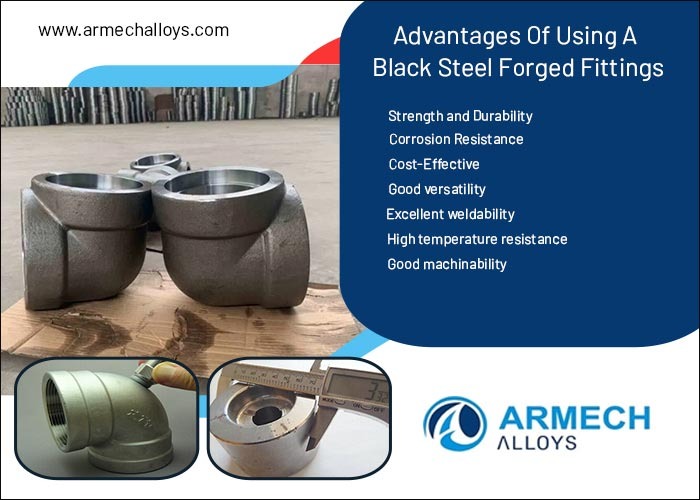
Pipe fittings are the undeniable workhorses of oil refineries, power plants, and petrochemical facilities. They’re the unsung heroes of the industry. When the stakes are high and there and there isn’t room for error, the only option for engineers is carbon steel forged fittings.
What Makes Forged Fittings Superior to Cast Fittings?
The key difference between forged and cast fittings is their method of manufacture. Forged fittings are made by heating a steel billet and then shaping the metal using a die under high pressure. This method creates fittings that are free from voids and have a uniform grain structure.
For fittings on a system that is under cyclic pressures and must meet the tolerances in ASME B16.11, cast fittings are unacceptable.
For piping systems that transport flammable liquids and gases, carbon steel forged fittings are the superior and safest option.
Choosing from Pressure Classes 3000, 6000, and 9000
One of the most common questions asked is “which pressure class should I use?”
For a precise answer, we require your system’s operating pressure and pipe schedule. Use the information below to guide you to the appropriate class.
Pressure Class Connection Type Pipe Schedule
3000# Socket Weld SCH 80 6000# Socket Weld SCH 160
3000# Threaded (NPT) SCH 160 6000# Threaded (NPT) SCH XXS
Simply increasing the rating of a pipe class does not improve safety. Increasing from Class 3000 to Class 6000 pipe adds thicker pipe walls, and increases the weight and cost of the pipe. Specify the class that correlates to the operating conditions of the system where possible. If you are unsure, contact the design engineer for assistance.
Connection Type: Welded vs. Threaded
This is the section of the document where most procurement teams have issues. Fortunately for them, both connection types are widely available.
Weldless (NPT/BSP) fittings are quicker to install as no welding is required and are ideal for low pressure non-critical lines particularly when fittings require frequent disassembly.
Welded fittings offer a permanent joint and a pipe is recessed and welded to the fitting. This joint is stronger and is optimal for higher pressures and for systems where leakage is a concern. This is the preferred connection type for pipe systems in oil, gas and power generation.
The downside is that since the socket weld connection system is more complicated, more time is needed to complete the project.
Industries That Use Carbon Steel Forged Fittings
The possible uses are many, including:
The oil and gas industry in both the upstream and downstream sectors
The petrochemical industry and the challenging vapors and fluids
Facilities that generate steam and operate at 800°F/427°C
Forged fittings have applications in shipbuilding and in piping systems that are subjected to very high levels of vibration
Mining and the associated slurry systems that are both abrasive and high pressure
Fire protection systems that guarantee no failure at any time
Things to Consider When Buying CS Forged Fittings
Since the quality of suppliers varies, the following should be considered in built up order and priority:
Is the material certified to ASTM A105, the standard for Carbon Steel Forged Fittings?
Is the EN 10204 3.1 or 3.2 material test report (MTR) provided? Serious suppliers provide this report each time.
Are the fittings manufactured and tested as per the requirements of ASME B16.11? This standard covers all fittings, including the pressure ratings of the fittings.
What are the corrosion protection options and what are the coating options?
What is the standard and non-standard fittings lead time?
If the answers to these requirements are not met or are unsatisfactory, it is a good idea to look for other suppliers.
Final Word
Under harsh conditions of high pressure and temperature with the added risk of failure, carbon steel forged fittings are the right choice. The initial cost of carbon steel forged fittings are higher than standard fittings, however, the cost of failure and the long service life and strong safety record of these fittings provide the best value on the market.
These fittings are a great solution for new systems, but are also a perfect choice for the replacement of older fittings in existing systems. Getting the grade, pressure class and end connection correct for the fittings is a critical design choice for system safety and functionality, but will also be greatly cost effective over the service life of the system.

FURTHER READING...

A Closer Look at Popular Vape Products in Australia
August 26, 2026


Choosing the Right Driving School for Safe, Confident Driving
August 24, 2026



Your Trusted Choice for Taxi Transportation Across Connecticut
August 24, 2026


Latest - post




CONTACT US
Category
- blog (350)
- Bookkeeping (5)
- Business (319)
- driving (5)
- Environment (5)
- Health (9)
- Home (74)
- Industrial Equipment (1)
- IT Security & Payment Solutions (1)
- Marketing (8)
- Medical (13)
- Relationship (4)
- Trade Show Displays (1)
- travel (15)
- Wedding Photography&Event (1)
